LLM SEO: how to get your site found, cited and recommended by AI models
LLM SEO makes your site easy for ChatGPT, Perplexity, Claude and Gemini to find, trust and cite. Crawlers, llms.txt, Perplexity SEO and a 10-step checklist.


LLM SEO is the practice of making your website and business easy for large language models to find, understand, trust and cite. It covers which AI crawlers can read your site, how your content is structured, and how consistent your facts are across the web, so ChatGPT, Claude, Gemini and Perplexity mention you when your customers ask.
This guide explains LLM SEO from the model's side: how LLMs get information, which crawlers to allow, whether llms.txt matters, how Perplexity SEO works, how to write content models cite, and how to use LLMs in your own SEO work without creating spam. It ends with a ten-step checklist for a local business site.
What is LLM SEO?
A working definition: LLM SEO means optimizing for large language models: getting your pages retrieved, quoted and cited, and your business named, in answers produced by AI assistants. People also call it LLMO, LLM optimization or AI SEO. LLM stands for large language model, the technology behind ChatGPT, Claude, Gemini and Perplexity.
The term overlaps heavily with generative engine optimization, which focuses on AI search answers, and with answer engine optimization (AEO). LLM SEO puts more weight on the model side of the system: what a model already knows about you from training, which of the company's crawlers can read your site, and how cleanly your content can be lifted into an answer.
Is LLM SEO the new version of SEO, and is SEO still important?
LLM SEO isn't a replacement or an equivalent of SEO; SEO is still the foundation. Google says its AI features retrieve pages with its core ranking systems and that optimizing for them "is optimizing for the search experience." What LLM SEO adds is attention to AI crawlers, quotable answers, entity consistency and tracking whether assistants actually name you, not just where your pages rank.
| Traditional SEO | LLM SEO | |
|---|---|---|
| Goal | Rank a page in results | Be named, quoted or cited in an AI answer |
| Crawlers that matter | Googlebot, Bingbot | Those, plus OAI-SearchBot, Claude-SearchBot, PerplexityBot |
| Unit of success | A click from a ranked link | A mention, a citation, a recommendation |
| Main risk | Not ranking | Being described wrongly, or not at all |
How do large language models find and use your content?
Large language models get information about your business in two ways. Training gives them a fixed snapshot of the web from before the model was built. Retrieval lets them search the web while answering, read current pages and cite them. Retrieval is the part you can influence quickly.
Retrieval, often called retrieval-augmented generation or grounding, works like this: the assistant turns the question into one or more searches, fetches a handful of pages from its index or a search partner, and writes an answer from them. Google's guide to generative AI search describes exactly this for AI Overviews and AI Mode, including query fan-out, where one question becomes several related searches.
Each assistant has its own "LLM SEO index":
- ChatGPT search uses pages crawled by OpenAI's OAI-SearchBot.
- Claude uses Claude-SearchBot to index pages and Claude-User to fetch them when a user asks.
- Perplexity searches in real time with its own crawler, PerplexityBot.
- Gemini uses Google Search and, for places, Google Maps data like addresses, hours and ratings.
- Copilot draws on Bing, and Microsoft says its grounding "powers nearly every major AI assistant in the market."
None of these companies publishes how it picks which sources to use. Perplexity's own help page only says it gathers "insights from top-tier sources" and that "each answer includes numbered citations." Anyone claiming to know the exact formula is guessing. What's consistent across all of them: they can only use what they can fetch, and they favor pages that answer the question clearly.
Which AI crawlers should you allow in robots.txt?
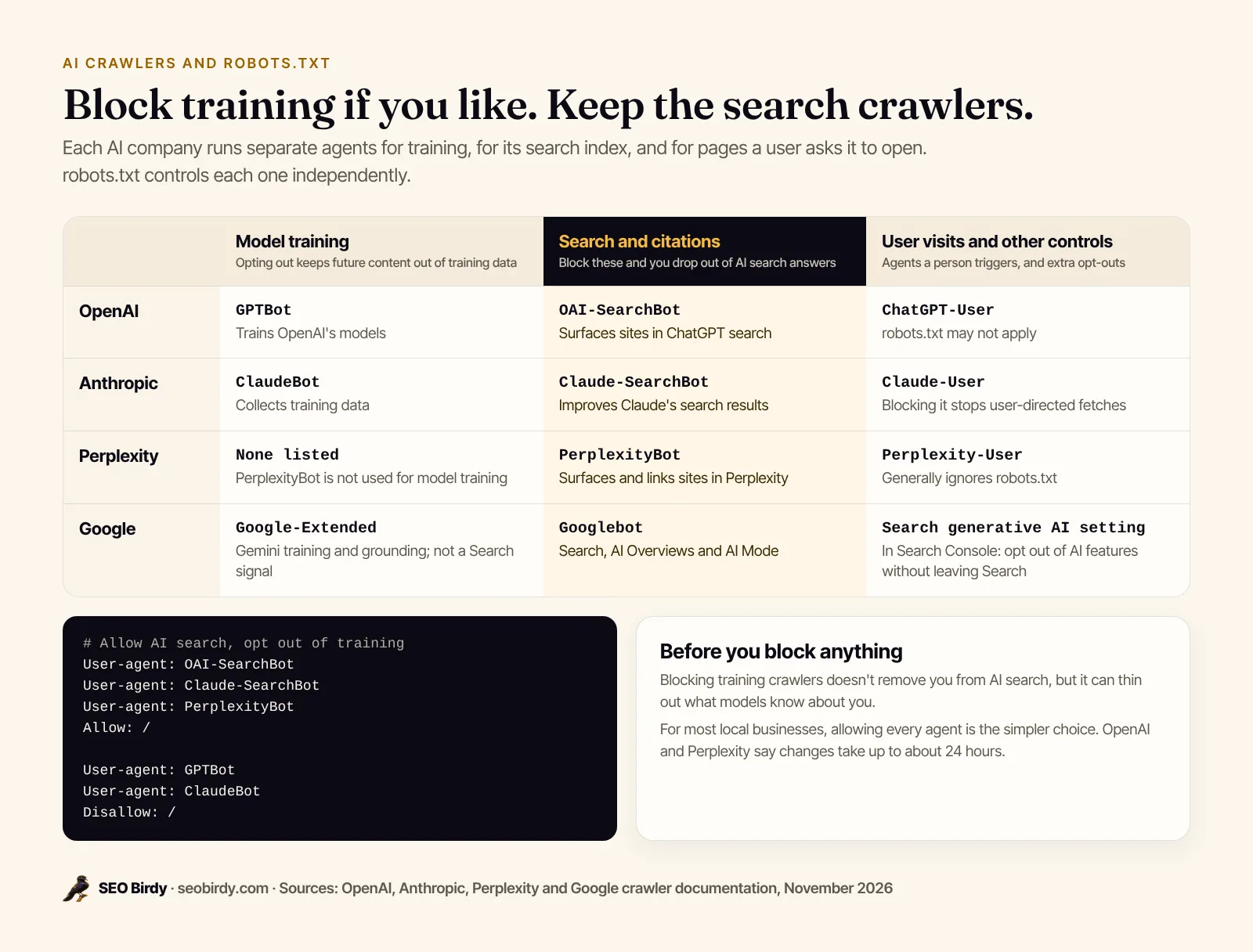
Allow the search crawlers, OAI-SearchBot, Claude-SearchBot, PerplexityBot, Googlebot and Bingbot, because blocking them removes you from those assistants' answers. Training crawlers like GPTBot and ClaudeBot are a separate choice: blocking them keeps future content out of model training without affecting search.
What each company documents:
- OpenAI (bots documentation): sites that block OAI-SearchBot "will not be shown in ChatGPT search answers." GPTBot is for training. ChatGPT-User visits pages users ask about, and robots.txt rules may not apply to it.
- Anthropic (crawler help page): blocking Claude-SearchBot "may reduce your site's visibility and accuracy in user search results." ClaudeBot collects training data.
- Perplexity (crawler documentation): PerplexityBot surfaces and links sites in results and "is not used to crawl content for AI foundation models." Perplexity-User handles user requests and generally ignores robots.txt.
- Google (common crawlers): Google-Extended controls whether content is used to train Gemini models and to ground Gemini answers, and "does not impact a site's inclusion in Google Search." AI Overviews and AI Mode use Googlebot.
Be careful with Google-Extended. Because it also covers grounding, blocking it can keep your content out of Gemini's answers, not just its training. If you want to stay out of AI Overviews and AI Mode specifically, Google now offers a Search generative AI setting in Search Console, which it says isn't used as a ranking signal for the rest of Search.
Do AI crawlers render JavaScript?
Don't assume they do. Google renders JavaScript (its JavaScript SEO basics explain how), but other AI companies don't document rendering. If your services, prices and contact details only appear after scripts run, serve them in the initial HTML with server-side rendering or static generation. Next.js, WordPress and most site builders can do this.
Do you need an llms.txt file for LLM SEO?
No, you don't need llms.txt for Google, and it's optional everywhere else. llms.txt is a proposal by Jeremy Howard for a Markdown file at your site's root that summarizes the site for AI agents. It isn't a formal standard, and Google says AI text files won't help or hurt your visibility in its Search.
Google's guide is explicit: "You don't need to create new machine readable files, AI text files, markup, or Markdown to appear in Google Search." Other services may read the file, so adding one is harmless and quick if your platform supports it. For a local business, it ranks well below fixing your robots.txt, listings and service pages.
Perplexity SEO: how do you get cited by Perplexity?
Perplexity SEO means getting your pages used and cited in Perplexity's answers. Allow PerplexityBot in robots.txt and through any firewall, make sure your pages are indexed in the major search engines, and write pages that answer specific questions directly, because every Perplexity answer shows its sources as numbered citations.
Practical steps:
- Allow PerplexityBot. Perplexity recommends allowing it in robots.txt and permitting its published IP ranges; changes can take up to 24 hours.
- Be the clearest source for a narrow question. Perplexity answers are short and sourced. A page titled "How much does a roof inspection cost in Tampa?" with the answer in the first paragraph is easy to cite.
- Show evidence. Specific numbers, dates, licenses and sources give an answer engine something verifiable to quote.
- Get mentioned where Perplexity already looks. Ask Perplexity your customers' questions and note the cited domains. Those are the review sites, directories and local publications to be present on.
- Check what it says about you. Ask "What do you know about [business] in [city]?" and correct any wrong source it cites.
Perplexity doesn't document using Google Business Profile, so don't rely on it. Keep your details consistent across your site, Bing Places, Yelp and industry directories instead.
Perplexity parasite SEO and other shortcuts
"Parasite SEO" means publishing pages on someone else's high-authority site to borrow its reputation. Aimed at AI answers, it's still the same tactic, and Google's spam policies prohibit site reputation abuse. Reddit threads full of "LLM SEO methods" that rely on fake posts or planted mentions fall in the same bucket. They can work briefly, then get removed.
How do you write LLM-friendly content that gets cited?
The best LLM SEO tip is simple: write content that answers the question in the first sentence, backs it with specific facts and sources, covers the follow-up questions, and makes clear who you are and where you work. LLMs cite passages they can lift into an answer and trust enough to attribute.
What that looks like on the page:
- Answer first. Put a 40 to 60 word direct answer under each heading. Then explain.
- Be specific. "Same-day drain cleaning across Phoenix, Mesa and Tempe, $175 to $350" beats "fast, affordable service."
- Cite your sources. Link to codes, manufacturers and official guidance. The original GEO study found adding citations, quotes and statistics raised visibility in AI answers, while keyword stuffing lowered it.
- Cover the sub-questions. Cost, timing, who it's for, what can go wrong. The free Fan-Out Map lists them from real searches.
- Show experience. E-E-A-T (often written EEAT) still applies: who did the work, licenses, years in business, real photos.
- Add an FAQ. Short, self-contained answers in customers' words are easy to quote.
- Use structured data where it fits. LocalBusiness schema or Organization markup states your name, address and profiles plainly. Google says it isn't required for AI features, but it removes ambiguity.
Notes for ChatGPT, Claude and Gemini
The basics are the same for every assistant; the differences are in sources. For ChatGPT, OAI-SearchBot access and a solid Bing presence matter, which is why our guide to getting your business on ChatGPT spends a whole step on Bing. For Claude, allow Claude-SearchBot and Claude-User. For Gemini, your Google Business Profile and Google rankings matter most, since it draws on Google Search and Maps.
LLM SEO for local businesses
For a local business, the facts matter more than the prose. An LLM recommending a dentist in Austin needs to confirm the practice exists, where it is, what it offers and that patients like it. That comes from a complete Google Business Profile, a matching Bing Places listing, consistent directory listings, recent reviews and a page per service. Our local SEO checklist covers the listing side.
An LLM SEO strategy: the checklist and playbook
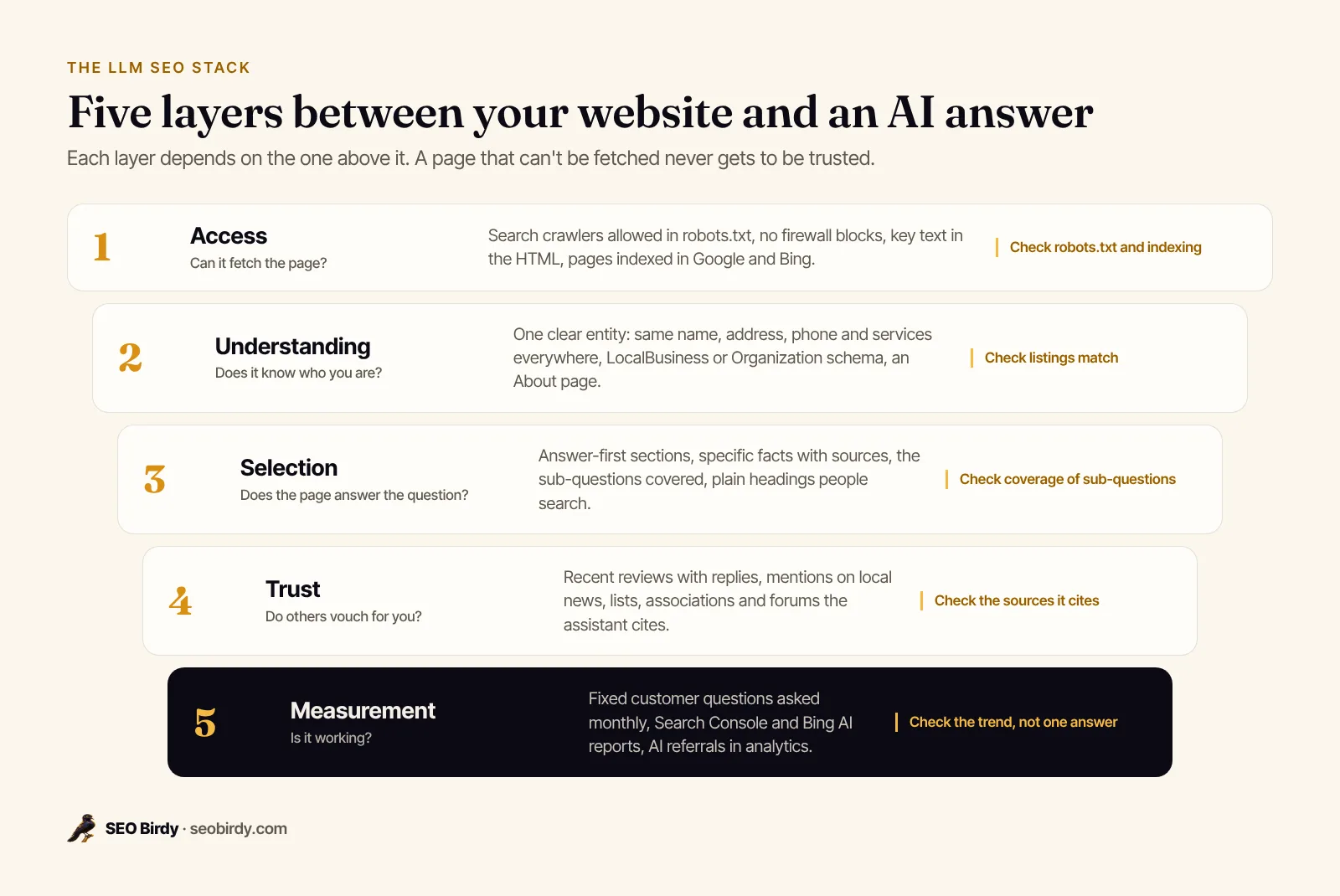
The simplest way to improve LLM SEO is to work through this ten-step checklist and playbook in order. It follows the same strategic framework as the five-layer stack above: access, understanding, selection, trust, measurement. The first four steps are about access and facts and usually take a day; the rest are content, reputation and tracking, which run continuously.
- robots.txt allows OAI-SearchBot, Claude-SearchBot, PerplexityBot, Googlebot and Bingbot.
- No firewall or CDN rule blocks those agents' published IP ranges.
- Key content is in the HTML, not only rendered by JavaScript or inside images.
- Pages are indexed in Google Search Console and Bing Webmaster Tools, with sitemaps submitted.
- Business facts match across your site, Google, Bing Places, Yelp and industry directories.
- Schema markup describes your business accurately and matches the visible page.
- Each service has its own page with an answer-first intro, prices or ranges, and an FAQ.
- Claims are sourced, with links to official guidance and real numbers you can back up.
- Reviews and mentions are growing, on the sites assistants already cite for your category.
- Visibility is monitored monthly and benchmarked against competitors: the same customer questions across assistants, plus Search Console's Generative AI performance report, Bing's AI Performance report and AI referrals in analytics.
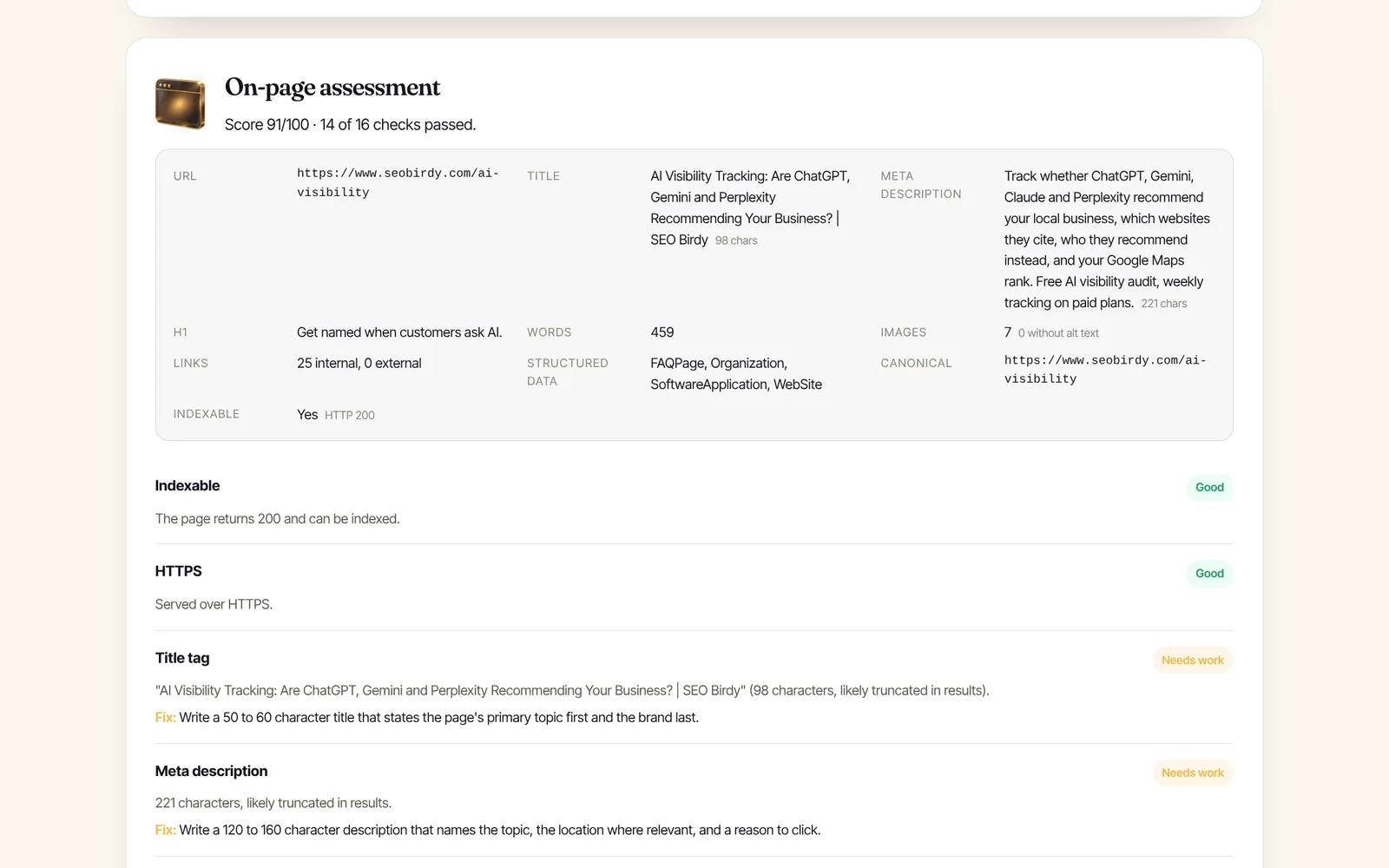
A free Website SEO Audit checks the on-page side of steps 3, 4 and 6 (whether a page is indexable, how much content its HTML carries, and its structured data), along with titles, headings, alt text and FAQ content.
For step 10, a tool saves hours. Developers will also find open-source scripts on GitHub that query assistants' APIs, which work but need upkeep as models and APIs change. Doing it by hand means asking each assistant every question and logging the results; our guide to AI search visibility covers the metrics and the free Search Console and Bing reports.
Check what LLMs say about your business. The free AI Visibility Audit asks ChatGPT, Gemini, Claude and Perplexity your customers' questions with live web search, then shows whether you're recommended, how high, whether your site is cited, and which competitors get named instead.
Run the free AI Visibility Audit →How should you use LLMs for your own SEO work?
LLM-powered SEO works best when you use LLMs as assistants for research, outlines, first drafts and rewording, and keep a human in charge of facts and final edits. Google says "appropriate use of AI or automation is not against our guidelines," but pages produced mainly to manipulate rankings, at scale, break its spam policies regardless of who or what wrote them.
There's no single best LLM for SEO writing. Choose by the job:
| Job | Where an LLM helps | Where you still need a person |
|---|---|---|
| Research | Summarizing sources, finding questions people ask; Perplexity shows citations you can check | Verifying every fact and number |
| Outlines | Turning a list of sub-questions into a structure | Deciding what your customers actually need |
| Drafts | A first pass at a service page or FAQ | Adding prices, local detail, photos, experience |
| Editing | Tightening, simplifying, fixing grammar | Keeping your voice and accuracy |
| Technical | Writing schema or robots.txt drafts | Testing them before you publish |
The failure mode is publishing raw output: generic pages that say what every other page says. Google's guidance on AI-generated content focuses on the quality of the result, not the tool, and its AI search guide asks for "non-commodity content." An LLM can't supply your prices, your service area or the job you did last Tuesday. You can.
Should you hire an LLM SEO agency or expert?
Hire help if you don't have time for the checklist above, but judge any LLM SEO agency, consultant or specialist on specifics. Ask what they'll change on your site and listings, how they'll measure results across assistants, and how they get mentions. Walk away from guaranteed placement in ChatGPT or Perplexity, since no assistant sells or guarantees organic recommendations. If you'd rather learn it yourself, skip paid courses at first: Google's AI search guide, the AI crawler docs linked above and Bing's webmaster blog are the primary sources. To check anyone's work, run the same questions before and after with the free AI Visibility Audit.
Frequently asked questions
What does LLM stand for in SEO?
LLM stands for large language model, the kind of AI behind ChatGPT, Claude, Gemini and Perplexity's answers. LLM SEO, sometimes called LLMO or LLM optimization, is the work of making your website and business easy for those models to find, understand, trust and cite when they answer questions.
Is LLM SEO different from GEO?
Mostly in emphasis. Generative engine optimization (GEO) focuses on AI search answers and citations. LLM SEO is a broader label that also covers how models learn from training data and which AI crawlers you allow. In practice the work overlaps: crawlable pages, clear answers, consistent facts, real reviews and genuine mentions.
Should I block GPTBot and ClaudeBot?
It's a business decision. Blocking GPTBot or ClaudeBot opts your future content out of model training, but it doesn't remove you from ChatGPT or Claude search answers, which use OAI-SearchBot and Claude-SearchBot. Most local businesses gain little from blocking training, since being well described in a model's knowledge can only help them.
Is Perplexity good for SEO research?
Perplexity is useful for SEO research because it searches the web in real time and shows numbered citations, so you can check where each claim came from. Use it to see which sources it cites for your topic and city. Don't treat its answers as search volume data or rankings, and check facts before you publish them.
Which LLM is best for SEO writing?
The model matters less than the process. Any capable model can help with outlines, first drafts and rewording, but none knows your prices, service area or customers. Give it your real facts, edit every draft yourself, and add first-hand detail. Google says appropriate use of AI is fine; mass-produced pages made to rank are not.
Does LLM SEO work for local businesses?
Yes, and local businesses have an advantage: when someone asks an AI who to hire in their city, it needs local facts, which come from your website, Google and Bing listings, reviews and local coverage. Keeping those accurate and consistent is the core of LLM SEO for a plumber, dentist or law firm.
Can you manipulate what LLMs say about your business?
Not reliably, and trying is risky. Hidden instructions to AI, fake reviews, paid fake mentions and spammy pages on other sites can be ignored, removed or penalized under search engines' spam policies. The durable approach is to make accurate, helpful information about you easy to find on your own site and on sites others trust.
We build SEO Birdy's audits and autopilots, and we test every recommendation against live search results and AI answers before we publish it. Our guides follow Google Search Central and Bing Webmaster guidelines.