Generative engine optimization (GEO): what it is, what works, and how to do it
Generative engine optimization (GEO) gets you named and cited in AI answers. What it is, what the research found, and a 7-step plan you can start this week.


Generative engine optimization (GEO) is the practice of making your business and your pages show up inside AI-written answers: named in the recommendation, quoted in the text, and linked as a source. Where classic SEO aims for a ranked link, GEO aims to be part of what Google's AI Overviews, ChatGPT, Gemini, Perplexity and Copilot actually say.
This guide explains generative engine optimization in plain English: where the term came from, what the original research found, how it differs from SEO and AEO, what Google and Microsoft say about it, and a seven-step plan you can start this week. The examples lean local, because that's where AI answers now decide who gets the call.
What is generative engine optimization?
A simple definition: generative engine optimization is the work of improving how often an AI system that writes answers, rather than listing links, uses your content and names your brand. The "generative engine" is any search tool that generates a response from web sources: AI Overviews and AI Mode in Google, ChatGPT search, Gemini, Perplexity and Microsoft Copilot.
Google's own guide to optimizing for generative AI search acknowledges the terms directly: AEO and GEO "are both terms you may see used to describe work specifically focused on improving visibility in AI search experiences." Microsoft goes further and defines GEO as "the practice of understanding how content participates in AI-driven experiences" in a February 2026 Bing post on grounding.
A quick note on the name. People also say "GEO SEO," and searches mix it up with geotargeting and geo-grid rank tracking. Here GEO means generative engine optimization only. If you're after map rankings by neighborhood, that's local rank tracking.
Why is generative engine optimization important?
The main benefit of GEO is reach where decisions now happen: AI answers sit above the links and change what people click. GEO matters because AI answers now sit above the links and change what people click. In a Pew Research Center study of 900 US adults' browsing in March 2025, users clicked a traditional result on 8% of visits when an AI summary appeared, versus 15% when none did.
Scale is the other reason. Google says AI Overviews has over 2.5 billion monthly active users and AI Mode more than one billion. When the answer itself names three roofers in Tampa, being one of the three is worth more than being the seventh blue link below it. Google also says clicks from AI Overviews tend to be higher quality, with visitors spending more time on the site.
How does generative engine optimization work?
Generative engines work in two stages: they search for sources, then write an answer from what they retrieved and link to some of it. GEO works on both stages: making sure your pages are found in the search step, and making them easy to use and cite in the writing step.
Google describes both stages in its AI optimization guide. Its AI features use retrieval-augmented generation, also called grounding, which relies on Google's normal ranking systems to fetch pages from the Search index. They also use query fan-out: one question becomes several related searches, so a page can be pulled in for a sub-question the user never typed. Our guide to query fan-out explains that step in detail.
Other assistants run their own versions. ChatGPT search crawls with OpenAI's OAI-SearchBot, Perplexity with PerplexityBot, and Copilot draws on Bing. None of them publishes a full formula for which sources win, so be skeptical of anyone who claims to know one. What's documented is the shape: be retrievable, be relevant to the sub-questions, and be clear enough to quote.
Where did GEO come from? The research behind it
The term comes from a paper by researchers at Princeton University and IIT Delhi, with two independent co-authors: GEO: Generative Engine Optimization, first posted in November 2023 and accepted to KDD 2024. They built GEO-bench, 10,000 queries across many topics, and tested nine ways of rewriting web content.
The setup was a lab version of AI search: for each query, the top five Google results were fed to GPT-3.5, which wrote a cited answer. The researchers then rewrote one source at a time and measured how much of the answer drew on it. The abstract's headline is that GEO "can boost visibility by up to 40% in generative engine responses."
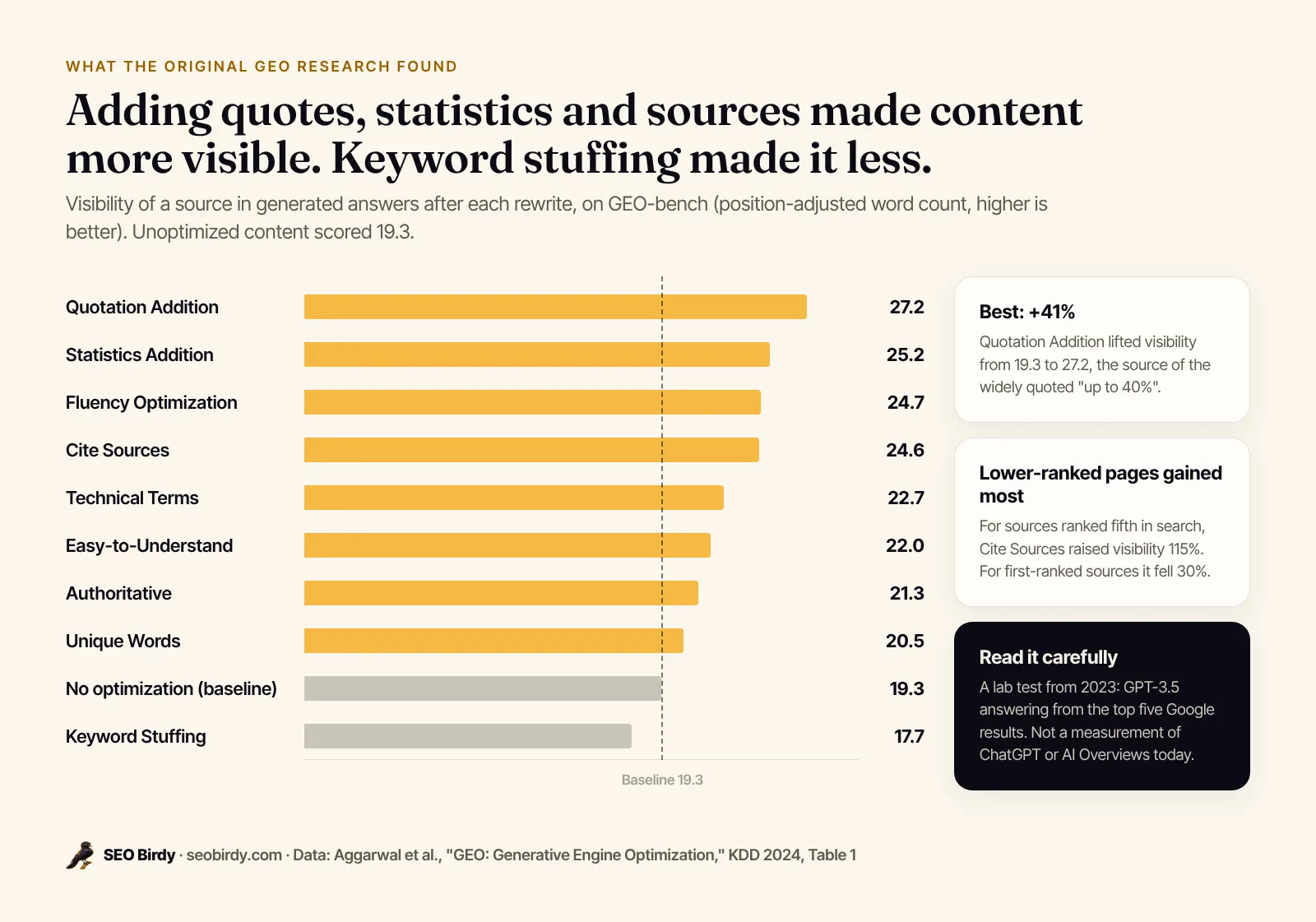
Three findings are worth keeping:
- Evidence beat style. Adding relevant quotations, statistics and citations to credible sources did best. Making text sound more "authoritative" did much less.
- Keyword stuffing backfired. Repeating the query's keywords scored below doing nothing.
- Smaller sites gained most. For sources ranked fifth in search, adding citations raised visibility by 115%; for top-ranked sources, the same change lowered it.
Keep the limits in mind. This was a 2023 experiment on a simulated engine, scored by its own visibility metric, and AI search has changed a great deal since. It's good evidence for a principle, that specific, verifiable content gets used more, not a recipe for any particular assistant today.
GEO vs SEO vs AEO: what's the difference?
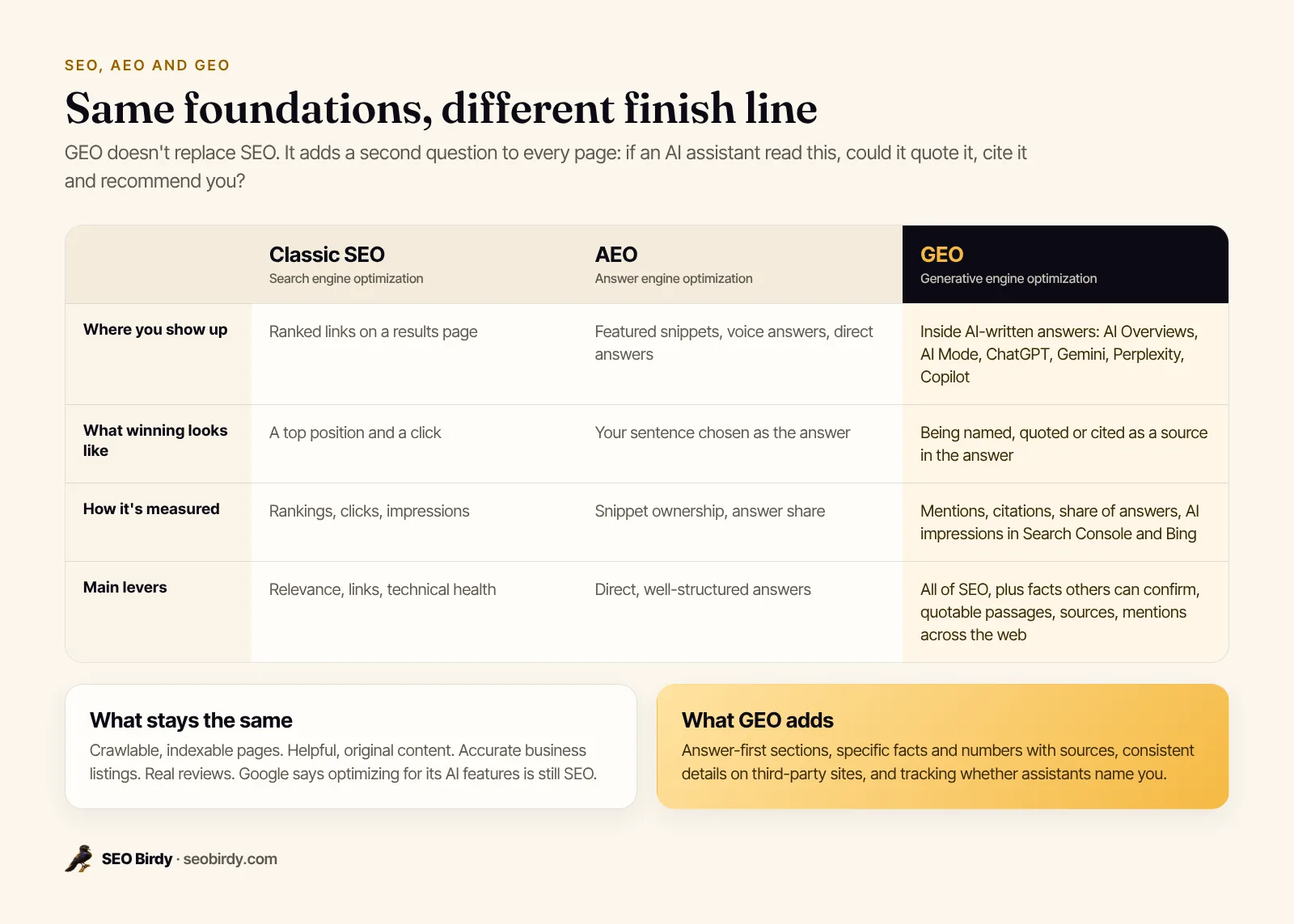
SEO aims for ranked links, AEO aims for the single passage chosen as a direct answer, and GEO aims for a mention or citation inside an AI-written response. They share almost all their foundations. GEO is best understood as SEO with an extra test: could an assistant quote this, verify it and recommend you?
Is GEO replacing SEO?
No. Google is blunt about it: "From Google Search's perspective, optimizing for generative AI search is optimizing for the search experience," which makes it SEO. Its AI features retrieve pages with the same ranking systems, so a page that can't rank or be indexed rarely gets cited. GEO is not the new SEO; it's where good SEO now pays off.
What about AIO, LLMO and AI SEO?
They're the same idea with different labels. AIO (AI optimization), LLMO (large language model optimization) and "AI SEO" all describe getting visible in AI answers. Our guide to LLM SEO covers the model side: training data, AI crawlers, and how each assistant fetches pages.
What do Google and Bing say about GEO?
Both search engines publish guidance, and both point back to fundamentals. Google says there are no special requirements or optimizations for its AI features beyond being indexed and eligible for a snippet. Bing gives a short list of practical advice: depth, clear structure, evidence, freshness and accurate local listings.
Google's AI features documentation says: "There are no additional requirements to appear in AI Overviews or AI Mode, nor other special optimizations necessary." Its AI optimization guide adds a mythbusting list of things you don't need to do for Google:
- Create llms.txt or other "AI text files," markup or Markdown versions of pages
- Break content into tiny chunks ("There's no ideal page length")
- Rewrite content to cover every long-tail variation, since AI systems understand synonyms
- Add special schema.org markup for AI
- Chase inauthentic "mentions" across the web
Microsoft's AI Performance announcement lists what helps content get cited in Copilot and Bing's AI answers: build depth on topics where you're already cited, use clear headings, tables and FAQ sections, back claims with examples, data and sources, keep content fresh with IndexNow, and keep local listings current in Bing Places.
GEO strategies and techniques: a 7-step framework
The strategies that hold up across the research and both search engines' guidance are the same seven: be crawlable, answer first, add specific sourced facts, cover the sub-questions, keep your facts consistent everywhere, earn genuine mentions and reviews, and keep content fresh. Treat it as a beginner-friendly playbook: here's how to implement each step, with tips on checking your work.
1. Make sure every engine can reach your pages
Check that robots.txt allows Googlebot, Bingbot, OAI-SearchBot and PerplexityBot, that your important text is in the HTML, and that pages are indexed. Google's guide puts it simply: pages must be indexed and eligible for a snippet. A free Website SEO Audit flags noindex tags, crawl problems and missing basics in under a minute.
2. Lead every section with the answer
Write the direct answer in the first sentence or two under each heading, then explain. An assistant writing a two-line summary needs a passage it can use as is. "A water heater replacement in Phoenix usually takes four to six hours" is quotable. "Every home is different" is not.
3. Add specific facts, quotes and sources
This is the strongest finding from the GEO paper. Replace vague claims with numbers, named standards and citations: your warranty terms, licenses, response times, price ranges, and links to the code or manufacturer guidance you follow. Only use real figures you can back up.
4. Cover the questions behind the question
Because of query fan-out, a page about "roof replacement cost" gets judged on sub-questions too: cost per square foot, insurance, timing, materials, permits. Map those sub-questions before you write.
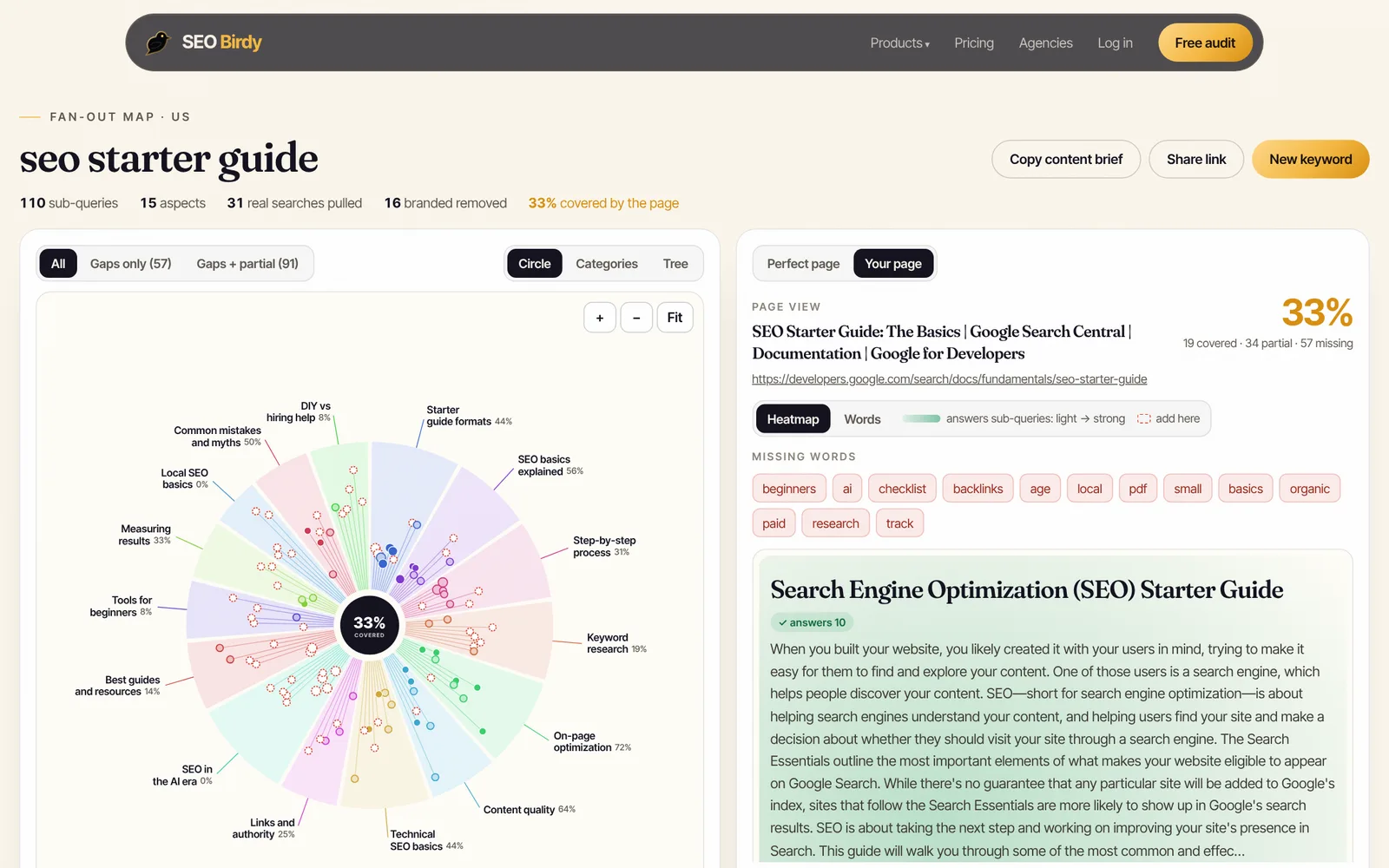
The free Fan-Out Map builds this list from real Google searches and shows which sub-questions a page already answers and which it misses.
5. Make your business facts identical everywhere
AI answers lean on facts they can confirm across sources. Keep your name, address, phone, hours, services and service area identical on your website, Google Business Profile, Bing Places, Yelp, the BBB and industry directories, and mark them up with LocalBusiness schema. Schema isn't required for AI features, but it removes ambiguity and supports rich results.
6. Earn reviews and genuine mentions
Be the business other sites talk about: steady reviews with replies, local news coverage, association memberships, sponsorships and "best of" lists that assistants cite. Google's warning about inauthentic mentions is the line to stay behind. Earned coverage helps; bought or fabricated mentions are a risk.
7. Keep content fresh and tell engines when it changes
Update prices, hours, photos and service details when they change, and use IndexNow so Bing and other participating engines hear about updates quickly. Microsoft specifically recommends it to keep information current in AI answers.
How does GEO work for local and small businesses?
For a local business, generative engine optimization mostly means being the easiest name to confirm when someone asks an assistant who to hire. That comes down to a complete Business Profile, a matching Bing Places listing, a page for each service and area, recent reviews, and mentions on the local sites assistants cite.
Picture a roofing company in Tampa. Someone asks ChatGPT, "Who's the best roofer in Tampa for storm damage?" An assistant that can find a page titled "Storm damage roof repair in Tampa," the same phone number on five directories, 200 recent reviews and a mention in a local news roundup has plenty to work with. A competitor with a thin homepage and mismatched listings gives it very little.
Google's guide makes the local link explicit: generative AI responses "can include product listings, product information, and information about local businesses," and Google Business Profile helps your services show up in AI responses and other results. Our step-by-step guides on getting your business on ChatGPT and Google Business Profile optimization turn this into a checklist. If you run a WordPress or Shopify site, nothing changes: GEO lives in your content and listings, not your platform.
What does GEO look like for ecommerce, hotels and other businesses?
The same principles change shape by business type. An ecommerce store's levers are product data: Google's guide points to Merchant Center feeds so products can appear in AI responses, and accurate prices, availability and specs on each product page. A hotel's are its Business Profile, room and amenity details, location facts and recent guest reviews. A B2B firm's are case studies, pricing pages and expert content that other sites cite.
How do you measure generative engine optimization?
GEO monitoring doesn't need expensive software. Measure it with three sources: Google Search Console's Generative AI performance report for impressions in AI Overviews and AI Mode, Bing Webmaster Tools' AI Performance report for citations in Copilot and Bing, and repeated checks of what assistants actually say for the questions your customers ask.
| Source | What it tells you | Limits |
|---|---|---|
| Generative AI performance report in Search Console | How often links to your site appeared in AI Overviews and AI Mode, by page, country, device and date | Impressions only; no clicks in this report |
| AI Performance in Bing Webmaster Tools | Citations, cited pages and the grounding queries behind them; Citation Share added in June 2026 | Sampled data; Microsoft says it's not a ranking |
| Prompt checks across assistants | Whether ChatGPT, Gemini, Claude and Perplexity name you, in what position, and who they name instead | Answers vary run to run, so repeat the same questions |
The KPIs that matter for most businesses: how often you're mentioned for your target questions, how often you're in the top three, how often your own site is cited, and whether leads from AI referrals grow. Our guide to AI search visibility covers metrics and reporting in depth, and the AI Visibility Audit runs the prompt checks for you.
Find out where you stand in AI answers today. The free AI Visibility Audit asks four AI assistants your customers' questions with live web search, and shows how often you're recommended, how high, whether your site is cited, and who gets picked instead.
Run the free AI Visibility Audit →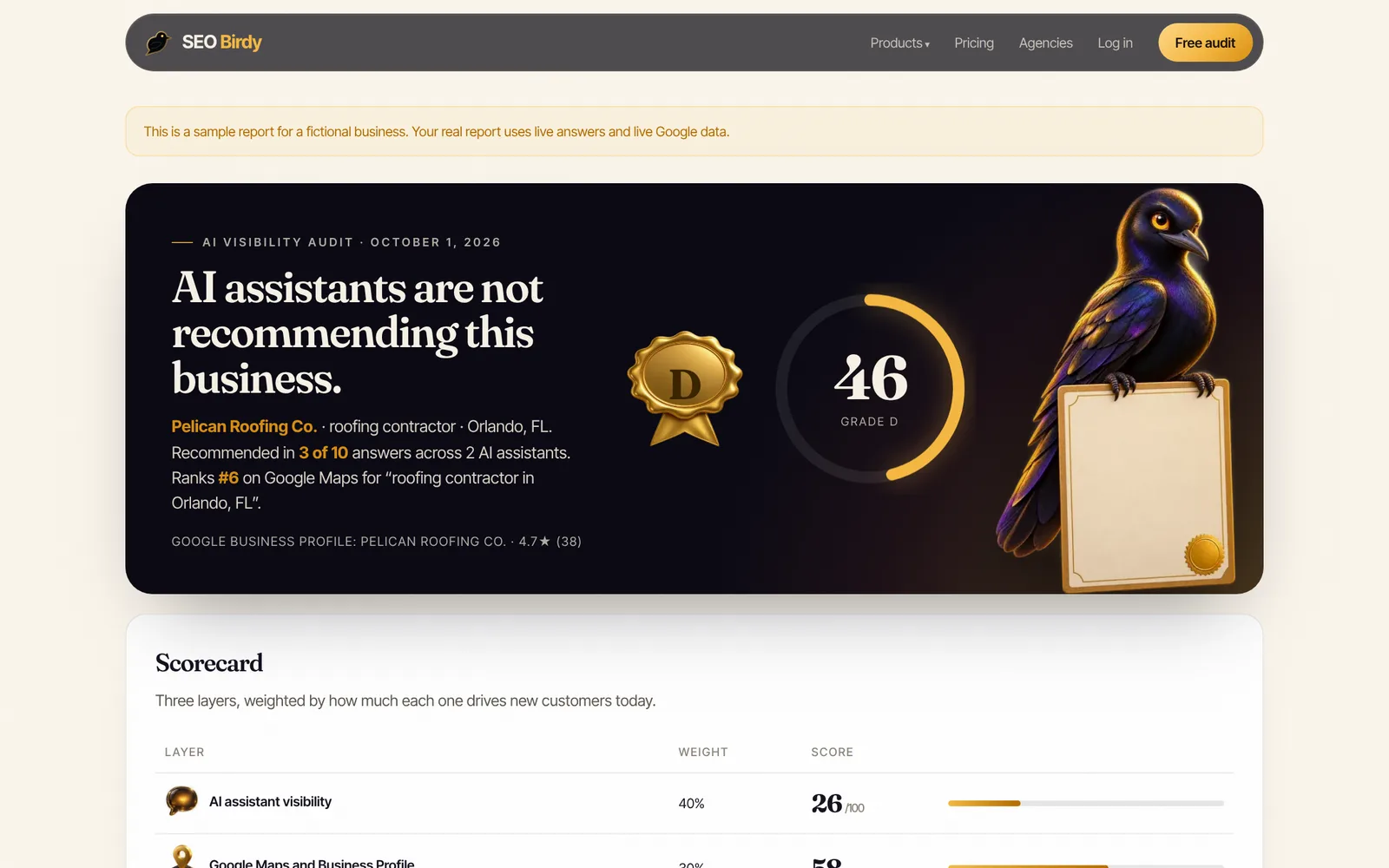
Should you hire a GEO agency or do it yourself?
Most small businesses can do the core of GEO themselves, because it's the same work as good local SEO: fix listings, improve service pages, ask for reviews and earn local coverage. Hire help when you lack the time, manage many locations, or need content written at scale, and judge any agency by the fundamentals.
Questions to ask a GEO agency or consultant:
- What will you change on my site and listings? Expect specifics, not "AI optimization."
- How will you measure it? Search Console, Bing Webmaster Tools and repeated prompt checks are reasonable answers.
- Do you guarantee placement in AI answers? If yes, walk away. No assistant sells or guarantees organic placement.
- Will you create pages in bulk? Mass-produced location pages can break Google's spam policies.
Google's guide also cautions that third-party tools claiming access to "internal" Google metrics or guaranteed success should be checked against official guidance. That applies to agencies too.
Is there a good generative engine optimization course or certification?
We're not aware of any official GEO certification from Google, Microsoft or OpenAI. The best free learning material is primary: Google's AI optimization guide, Bing's webmaster blog and the original GEO paper. Job titles like "GEO specialist" are appearing, but the skills are SEO, content and analytics skills applied to AI answers.
GEO myths and risks to avoid
You'll find plenty of debate about GEO on Reddit and SEO forums. The biggest GEO risks are shortcuts that try to manipulate AI answers: hidden instructions to AI systems, fake reviews, paid fake mentions and spun pages. These can get content ignored or flagged, and some tactics, sometimes called "GEO poisoning," are simply spam aimed at a new target.
- Myth: GEO is a scam. The term is new and oversold, and some offers are, but the underlying work (being findable, clear and trusted) is real. Judge offers by what they change, not the label.
- Myth: you need llms.txt. Not for Google, which says these files neither help nor hurt. Optional elsewhere.
- Myth: you must chunk content into tiny pieces. Google says there's no requirement and no ideal page length.
- Myth: GEO is just keyword stuffing for chatbots. The research found keyword stuffing made visibility worse.
- Risk: hidden text and prompt injection. Text written to instruct AI systems rather than inform readers is manipulation, and Google's spam policies already cover hidden text.
- Risk: fake mentions and reviews. Google warns inauthentic mentions aren't as helpful as they seem, and fake reviews break review policies.
The honest version of GEO is less exciting and more durable: be the most useful, most verifiable source for the questions your customers ask. That works for a ten-link results page and for an AI answer, and it will keep working as the assistants change.
Frequently asked questions
What does GEO stand for in SEO?
In SEO, GEO stands for generative engine optimization: improving how often your brand and pages appear, are quoted and are cited in answers written by AI systems such as Google's AI Overviews and AI Mode, ChatGPT, Gemini, Perplexity and Copilot. It's unrelated to geotargeting or geo-grid rank tracking, which also get called geo SEO.
Is generative engine optimization real or just a new name for SEO?
Both. The term comes from a peer-reviewed 2024 study, and AI answers really do choose and cite sources differently from a list of ten links. But Google says optimizing for its AI features is still SEO, and Bing's advice overlaps heavily with classic best practice. Treat GEO as an extra layer on top of SEO, not a replacement.
Who invented generative engine optimization?
The term was introduced by researchers from Princeton University and IIT Delhi, with two independent researchers, in the paper "GEO: Generative Engine Optimization," first posted to arXiv in November 2023 and published at the KDD 2024 conference. It proposed GEO-bench, a 10,000-query benchmark, and tested nine ways of rewriting content.
What's the difference between GEO and AEO?
Answer engine optimization (AEO) grew up around featured snippets and voice assistants, where one passage is picked as the answer. GEO targets AI-written answers that blend several sources and cite some of them. In practice the work overlaps almost completely: direct answers, clear structure, sourced facts and a site search engines can crawl.
Do I need llms.txt for generative engine optimization?
Not for Google. Its guide to generative AI search says you don't need new machine-readable files, AI text files or Markdown to appear, and that creating them neither helps nor hurts your Google visibility. Other services may read llms.txt, so it's a low-cost optional extra, not a priority for a local business.
How much does generative engine optimization cost?
There's no standard price. Most of the work is the same as good SEO: content updates, listings cleanup, review generation and earning local coverage, done in-house or by an agency. Costs depend on how many pages, locations and assistants you cover. Be wary of anyone who guarantees placement in AI answers, since no assistant offers a way to buy or guarantee one.
How long does GEO take to work?
Technical fixes and new pages can be picked up within days once they're crawled and indexed. Being named more often in AI answers usually takes months, because it depends on reviews, mentions and listings building up across the web. Track the same questions every few weeks and judge the trend over a quarter rather than week to week.
We build SEO Birdy's audits and autopilots, and we test every recommendation against live search results and AI answers before we publish it. Our guides follow Google Search Central and Bing Webmaster guidelines.