AI search visibility: how to check, measure and improve it
AI search visibility is how often AI answers name and cite you. Learn the metrics that matter, how to check them free, and what actually moves the numbers.


AI search visibility is how often AI-generated answers mention your business, recommend it, and cite your website as a source. It covers Google's AI Overviews and AI Mode, ChatGPT, Gemini, Perplexity, Copilot and Claude. You measure it by asking the questions your customers ask and counting how often, and how prominently, you appear.
This guide covers AI search visibility from the measurement side: what it is, the metrics worth tracking, how to check it for free, what Google Search Console and Bing Webmaster Tools now report, how to track it over time without being fooled by noisy answers, and what actually improves it. It's written for local business owners and the agencies that report to them.
What is AI search visibility?
By definition, AI search visibility is the share of relevant AI answers that include you. A business with high AI visibility gets named when someone asks an assistant "who's the best dentist in Austin," appears near the top of that list, and has its own website linked as a source. Low visibility means the assistant recommends others.
It's related to, but different from, search visibility in classic SEO. Search engine visibility usually means how often your pages appear in ranked results for the keywords you care about, weighted by position. AI visibility asks a narrower and more commercial question: when an AI writes the answer, are you in it?
Three things make it different to measure:
- There's no fixed results page. Answers are written fresh each time, so you measure frequency across many asks, not a single rank.
- Being named and being cited are separate. An assistant can recommend your business while citing a review site, or cite your page without naming you.
- Each assistant has its own sources. ChatGPT, Gemini and Perplexity can disagree about the same question on the same day.
Why does AI search visibility matter?
AI search visibility matters because AI answers increasingly sit between customers and your website. When an AI summary appears, people click fewer links, so the businesses named inside the answer get the attention. For local services, that short list can decide who gets the call.
The numbers are large. Google says AI Overviews has over 2.5 billion monthly active users, and AI Mode more than one billion. A Pew Research Center analysis of US browsing data found people clicked a traditional search result on 8% of visits with an AI summary, compared with 15% without one, and clicked a link inside the summary on about 1%.
That doesn't make SEO less important. It changes what success looks like. A plumber in Denver can rank third organically and still lose the customer if the AI Overview above the links names two competitors. Tracking AI visibility alongside rankings shows you that gap. It also shows brand awareness you'd otherwise miss: being recommended in ChatGPT builds trust even when the customer calls you directly instead of clicking.
Where does AI search visibility happen?
AI search visibility happens anywhere generative AI writes an answer from web sources: Google's AI Overviews and AI Mode, ChatGPT search, Gemini, Perplexity, Microsoft Copilot and Claude. Each one gathers information its own way, which is why your visibility can be strong in one and missing in another.
| Where | What feeds it | What you can measure officially |
|---|---|---|
| Google AI Overviews and AI Mode | Google's Search index, with query fan-out across related searches | Impressions in Search Console's Generative AI performance report |
| Gemini | Google Search and Google Maps place data | No dedicated report |
| ChatGPT search | Pages crawled by OAI-SearchBot and other web sources | Referral visits from chatgpt.com in analytics |
| Microsoft Copilot and Bing AI answers | Bing's index and Bing Places | Citations in Bing Webmaster Tools' AI Performance report |
| Perplexity | Pages crawled by PerplexityBot, cited with numbered links | Referral visits from perplexity.ai |
| Claude | Web search when a user's question needs it | Referral visits in analytics |
For the Google side in depth, see how to rank in AI Overviews. For the crawlers behind each assistant, see our guide to LLM SEO.
Which AI visibility metrics and KPIs should you track?
Track five metrics from your own checks and two from the official reports. From prompt checks: mention rate, top-3 rate, first-pick rate, citation rate and share of voice. From Google and Bing: AI feature impressions and citations. Together they show whether you're in answers, how prominently, and whether your site is trusted.
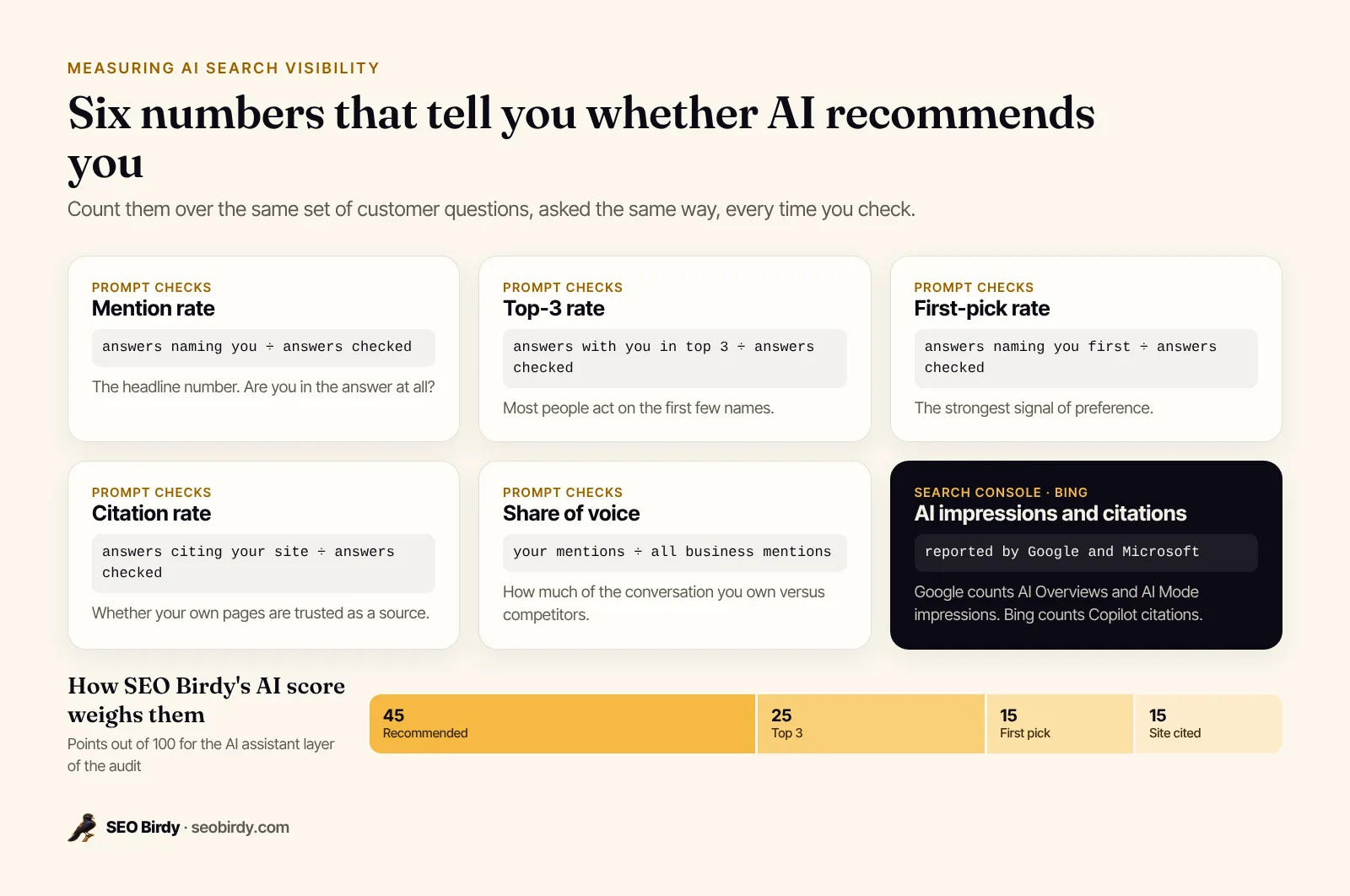
How to read them:
- Mention rate is your headline KPI. If you're named in 3 of 20 answers, that's 15%.
- Top-3 rate and first-pick rate show prominence. Being sixth in a list of six is visibility in name only.
- Citation rate tells you whether assistants trust your own pages. Low citation with decent mentions usually means they're relying on review sites and directories to describe you.
- Share of voice compares you with competitors: your mentions divided by all business mentions across the same answers.
- AI impressions (Google) and citations (Bing) are the only numbers measured inside the search engines themselves.
An AI visibility score rolls these into one number. Scores aren't standardized, so a 60 in one tool isn't a 60 in another. In SEO Birdy's audit, the AI assistant layer gives 45 points for being recommended, 25 for top-three placement, 15 for first pick and 15 for your website being cited, and it counts for 40% of the overall score, alongside Google Maps and your website at 30% each. Whatever tool you use, compare like with like over time.
How to check your AI search visibility for free
To check your AI search visibility for free, write ten customer questions for your service and city, ask each one in ChatGPT, Gemini, Perplexity and Google with web search on, and record whether you're named, your position, and which sites are cited. That gives you a baseline in about an hour.
- Write the questions customers actually ask. Mix intents: "best [service] in [city]," "[service] near me open now," "how much does [service] cost in [city]," "who do locals trust for [service]," and one emergency question if it fits your trade.
- Use a clean session. Log out or use a private window, and ask from your service area if you can, since location affects local answers.
- Ask each assistant the same wording. Turn web search on in ChatGPT. Note whether Google shows an AI Overview at all.
- Log the result in a sheet. Columns: date, assistant, question, named (yes/no), position, your site cited (yes/no), competitors named, sources cited.
- Add one branded question. "What do you know about [business] in [city]?" checks whether the facts are right.
Skip the spreadsheet. The free AI Visibility Audit asks ChatGPT, Gemini, Claude and Perplexity real customer questions for your service and city with live web search, then scores how often you're recommended, how high, whether your site is cited, and who's named instead.
Run the free AI Visibility Audit →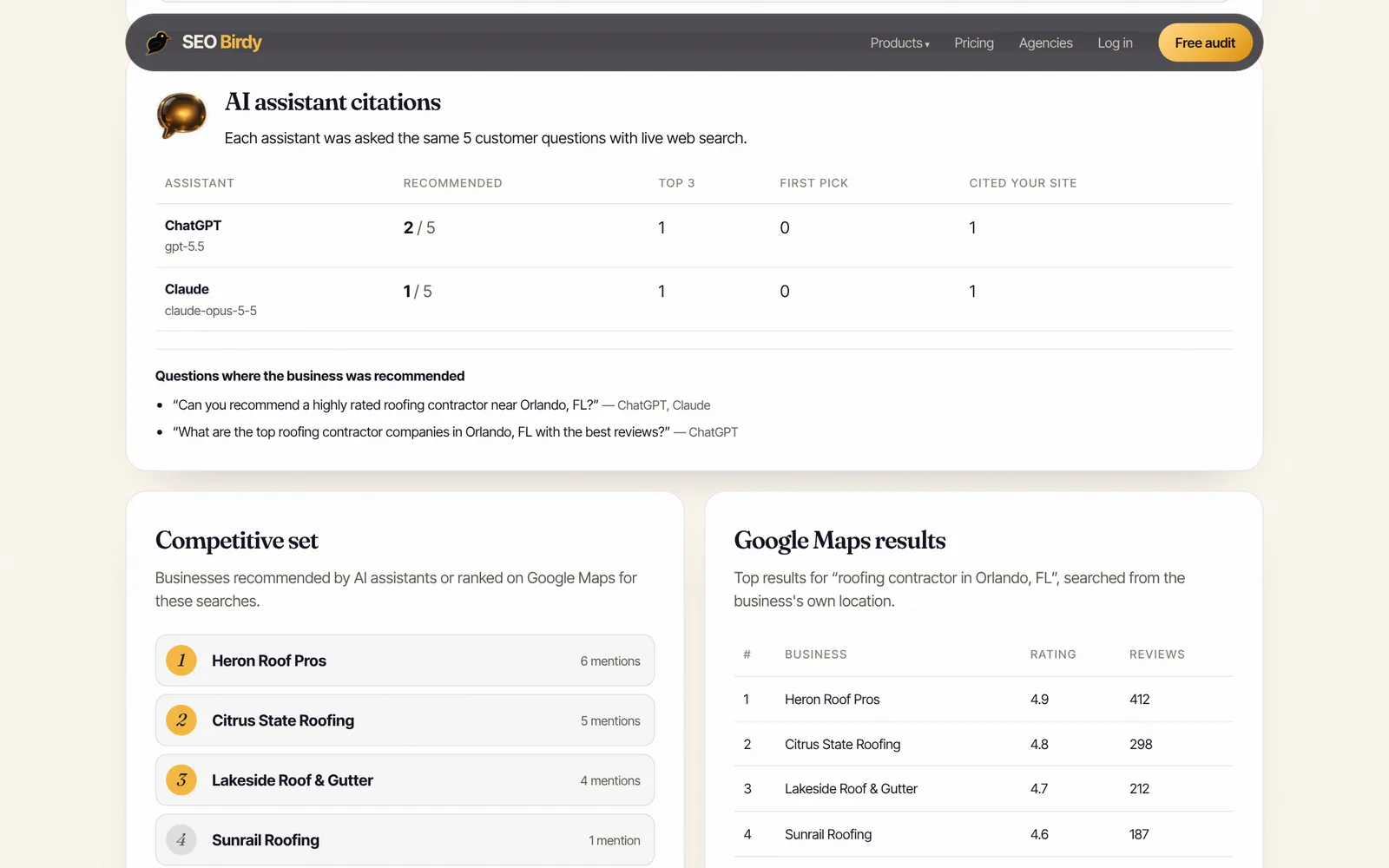
The free plan covers one business with five customer questions across every assistant, plus a Google Maps and homepage check, and a re-check every two weeks. You can see a full sample report first.
How do you measure AI visibility in Search Console and Bing?
Google Search Console and Bing Webmaster Tools both now report AI visibility for free. Search Console's Generative AI performance report counts impressions in AI Overviews and AI Mode. Bing's AI Performance report counts how often Copilot and Bing's AI answers cite your pages, and which grounding queries triggered them.
Google Search Console's Generative AI performance report
Google's Generative AI performance report shows how many times links to your site appeared in generative AI features on Google Search, with breakdowns by page, country, device and date. It covers AI Overviews and AI Mode; Discover has its own report. Key limits:
- It counts impressions, not clicks. AI feature clicks are still included in your overall Performance report totals under the Web search type, per Google's AI features documentation.
- Two results from your site in one AI answer count as one impression in the chart totals.
- The report may not appear if your site has too few AI impressions.
Search Console also added a Search generative AI setting under Settings. Sites are included by default; if you exclude yours, its links and content stop appearing in these features, and Google says the control isn't a ranking signal for the rest of Search. If your AI impressions are zero, check this setting first. New to the tool? Start with Google Search Console for beginners.
Bing Webmaster Tools' AI Performance report
Microsoft's AI Performance report, launched in public preview in February 2026, shows total citations across Microsoft Copilot, AI-generated summaries in Bing and select partner integrations, plus average cited pages per day, page-level citation counts and a sample of grounding queries. In June 2026 Bing added Intents (including a Local category), Topics, Citation Share and period comparison.
Microsoft is careful about what these numbers mean: average cited pages "does not indicate ranking, authority, or the role of any page within an individual answer," and it describes Citation Share as an observational metric, not a competitive scoreboard. Treat it as a direction of travel.
Your analytics: AI referrals
Finally, look at referral traffic in your analytics from chatgpt.com, perplexity.ai, gemini.google.com and copilot.microsoft.com. Visits from AI Overviews arrive as ordinary Google organic traffic, so they won't show separately. Track calls and form fills from AI referrals where you can, because a recommendation that brings a lead is the number your business cares about.
How do you track AI visibility over time?
AI visibility monitoring works best with a fixed set of questions, asked the same way on a schedule, logged in one place, and read alongside the Search Console and Bing reports. Monthly checks suit most businesses; weekly checks help while you're making changes. Never judge progress from a single run.
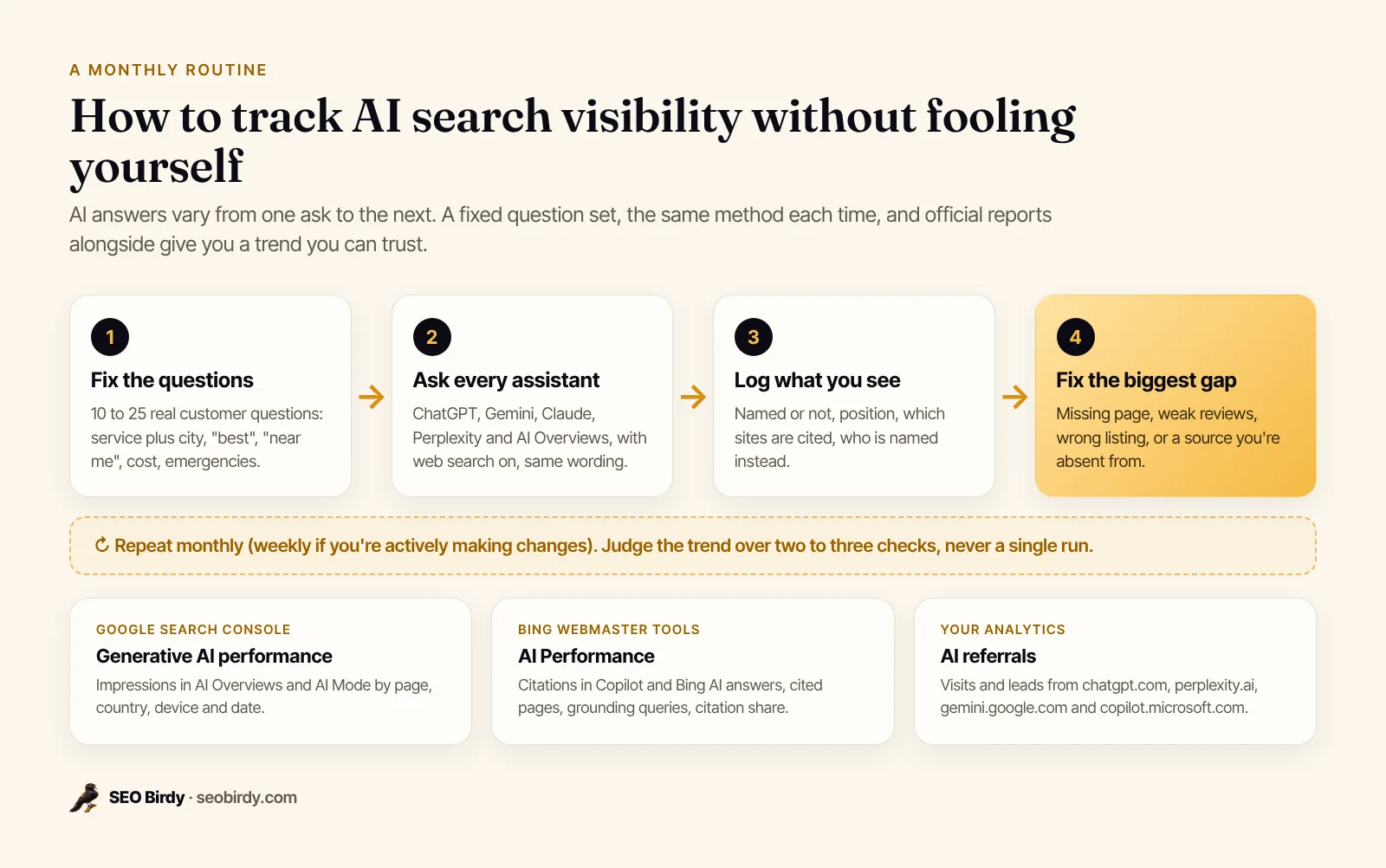
Answers change for reasons that have nothing to do with you: the model writes a new answer each time, the pages it retrieves shift, and small wording differences matter. A fixed question set and enough questions (ten to twenty-five) smooth that out. Record every run, and look for changes that hold across two or three checks.
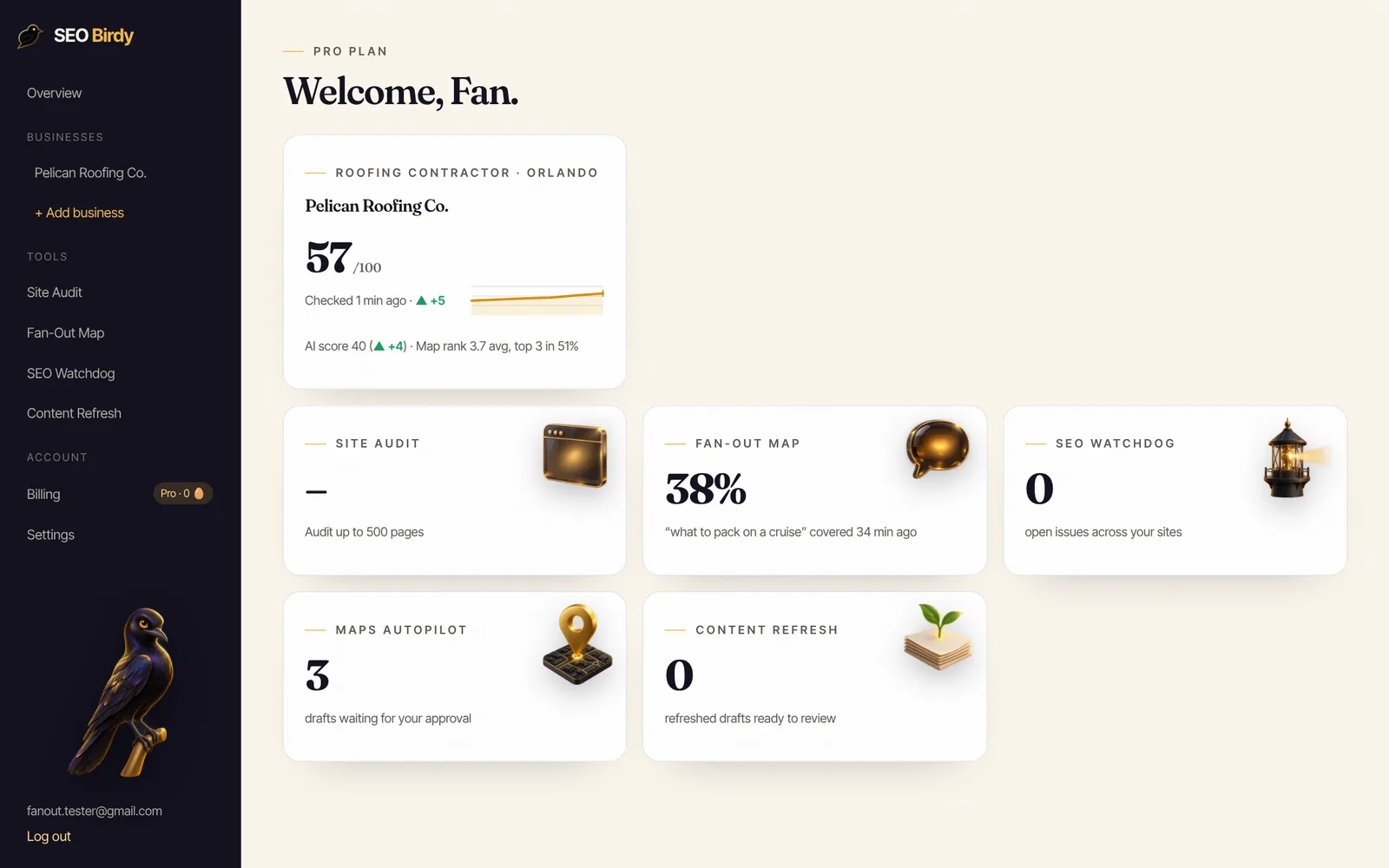
A dashboard helps once you're tracking several assistants and competitors. On SEO Birdy's paid plans, the AI visibility check re-runs every week, tracks competitors check over check, and charts your score.
What affects AI search visibility?
The factors that affect AI search visibility are the ones that make you easy to retrieve, easy to understand and easy to trust: being crawlable and indexed, ranking well in the underlying search engine, answer-first pages, consistent business details, recent reviews, and genuine mentions on sites assistants cite.
Here's what each factor does, and what the official guidance says:
| Factor | Why it matters | Where it's documented |
|---|---|---|
| Crawlable and indexed pages | AI features can only use pages they can retrieve | Google requires pages to be indexed and snippet-eligible |
| Organic ranking strength | Google's AI features retrieve with its core ranking systems | Google's AI optimization guide |
| Clear, answer-first structure | Headings, tables and FAQs help AI reference information accurately | Bing's AI Performance guidance |
| Consistent listings | Business Profile and Bing Places keep AI answers current | Google and Bing guidance |
| Reviews | More reviews and positive ratings help local ranking | Google Business Profile Help |
| Mentions on other sites | Assistants cite review sites, local news and lists | Visible in the sources they cite |
| Freshness | Updated pages get reflected sooner | Bing recommends IndexNow |
One technical note: "crawl waste" matters for large sites. If crawlers spend their time on duplicate, parameter or thin URLs, your important pages get fetched less often. Google's guide recommends reducing duplicate content for the same reason. For most local business sites with a few dozen pages, it's rarely the bottleneck.
How to improve and increase your AI search visibility
To improve AI search visibility, or boost it from zero, fix the gap your checks reveal, in order of impact: make sure you're indexable, build a clear page for each service and area, match your details across listings, grow recent reviews, and earn mentions on the sources assistants already cite for your category and city.
The tactics that increase AI visibility depend on what your data shows, so work from it rather than a generic checklist:
- Not named anywhere? Start with access and basics: robots.txt, indexing, Google Business Profile and Bing Places. Our guide to getting your business on ChatGPT walks through it step by step.
- Named, but low in the list? Compare review counts and recency with the businesses above you, and check whether they have a page for the exact service asked about.
- Named, but your site is never cited? Your pages aren't answering the question directly. Lead with the answer, add prices or ranges, and cover the sub-questions. The free Fan-Out Map shows which ones your page misses.
- Strong in one assistant, missing in another? Look at what that assistant cites. Gemini leans on Google Maps data; Copilot on Bing; ChatGPT and Perplexity on their own crawlers and the wider web.
- Facts wrong? Correct the source listing, then re-check in a few weeks.
The wider strategy behind these fixes is generative engine optimization.
Improving AI visibility for local businesses
Local businesses have an advantage: assistants answering "near me" and "in [city]" questions need local facts, and those come from listings, reviews and local sites you can influence. Keep your Google Business Profile complete, mirror it in Bing Places, ask every happy customer for a review, and join the local directories and associations that show up as sources. A law firm, a dentist and a roofer all follow the same pattern with different directories. Track your map rankings alongside AI answers with local rank tracking, since the two usually move together.
Ecommerce, B2B and startups
For ecommerce, AI visibility depends heavily on product data: accurate prices, availability and specs on product pages, and Google Merchant Center feeds, which Google says help products appear in AI responses. For B2B and SaaS, it depends on being cited in comparisons, reviews and expert content. Startups should expect a slow start, because there's little written about them yet. Enterprise brands face the opposite problem: plenty of mentions, some of them outdated or wrong, so accuracy across many pages and locations becomes the job.
AI visibility tools, audits and agencies: what to look for
Good AI visibility tools and monitoring software ask several assistants your real customer questions on a schedule, record who's named and which sources are cited, track competitors, and show trends, not just one score. A one-off AI visibility audit gives you a baseline and a fix list; ongoing tracking tells you whether the fixes worked.
How these tools work is simple: they send prompts to AI assistants, usually through their APIs with web search turned on, then parse the answers for business names, positions and cited URLs. That means results approximate what a customer sees rather than copying it exactly, since personalization and location can differ. Ask any vendor how they handle that.
What to check before you pay for one:
- Which assistants, and with live web search? An answer from model memory alone tells you little about local visibility.
- Can you add your own questions? Generic prompts miss your real services.
- Does it show competitors and cited sources? That's where the fix list comes from.
- How often does it re-check, and does it chart trends?
- Does it claim access to "internal" Google data or guarantee results? Google's guide explicitly warns about tools that do.
For agencies, consultants and in-house SEO specialists, AI visibility is becoming a reporting line next to rankings and calls. Report mention rate, top-3 rate and citation rate per assistant, with the same questions each month, and explain variability up front so clients don't overreact to one bad week. SEO Birdy's white-label program lets agencies offer these reports under their own brand, and our guide to white label local SEO covers how agencies package it. Plan limits and prices are on the pricing page.
Frequently asked questions
What is a good AI visibility score?
There's no industry standard, because every tool scores differently. In SEO Birdy's audit, the AI layer gives 45 points for being recommended, 25 for top-three placement, 15 for being the first pick and 15 for your website being cited. Compare yourself with the competitors named for the same questions, and focus on the trend rather than one number.
Can I see AI Overviews traffic in Google Search Console?
Yes. AI Overviews and AI Mode traffic is included in your normal Performance report totals under the Web search type, and Search Console now has a separate Generative AI performance report that shows impressions in those features by page, country, device and date. That report counts impressions; it doesn't show clicks.
How often should I check my AI visibility?
Monthly is enough for most local businesses. Check weekly while you're actively changing pages, listings or review campaigns, so you can connect changes to results. Always use the same questions and wording, and judge movement over two or three checks, because answers vary from one run to the next.
Is AI visibility the same as SEO visibility?
No, but they're linked. SEO visibility measures how often you appear in ranked results. AI search visibility measures how often AI-written answers name or cite you. Google's AI features retrieve pages with its normal ranking systems, so strong SEO helps, but a business can rank well and still be left out of AI recommendations.
Why does ChatGPT give different answers every time?
Each answer is generated fresh, and when web search is on, the pages it reads can change between runs. Small wording changes in the question also shift the result. That's why one screenshot proves little. Ask a fixed set of questions the same way each time and count how often you're named across all of them.
Do I need a paid tool to track AI search visibility?
No. You can track it with a spreadsheet, the free Search Console and Bing Webmaster Tools reports, and your analytics. A tool saves time by asking several assistants many questions on a schedule and logging competitors and citations for you. SEO Birdy's AI Visibility Audit is free for one business with five questions.
We build SEO Birdy's audits and autopilots, and we test every recommendation against live search results and AI answers before we publish it. Our guides follow Google Search Central and Bing Webmaster guidelines.